
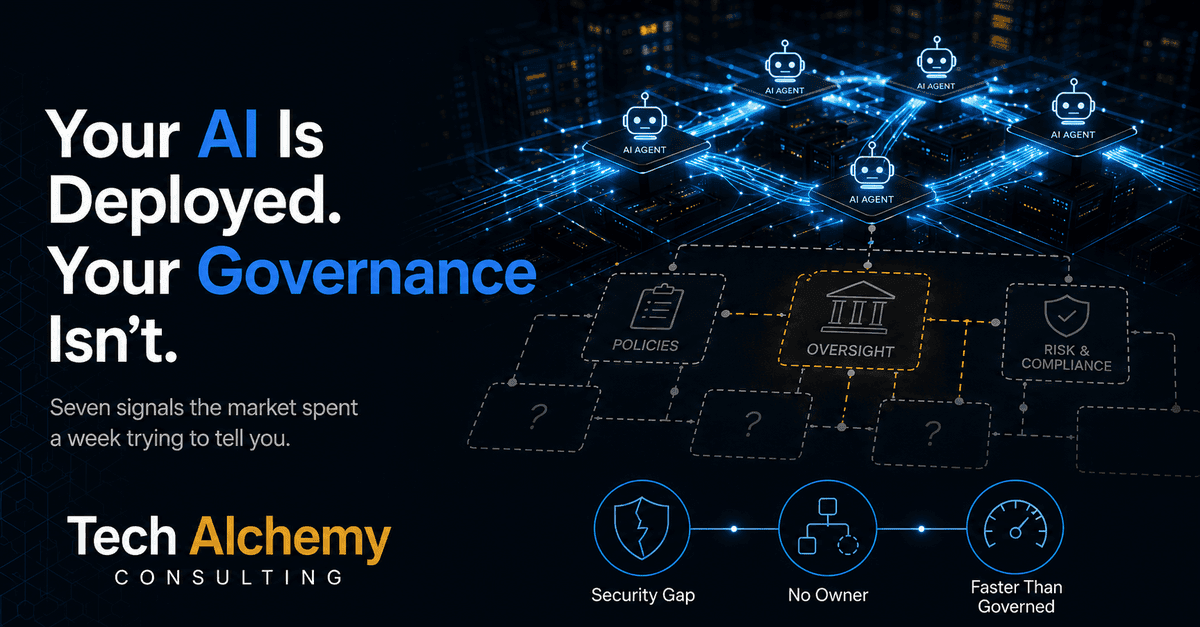
In a single week in July 2026, five independent editorial teams published seven separate articles about the same structural problem in enterprise AI. TechCrunch, VentureBeat, Axios, Forbes, and Fast Company did not coordinate. They arrived at the same story because the same pattern kept appearing in the organizations they cover.
The pattern: organizations are deploying AI faster than they are governing it, and the failures are no longer theoretical.
What Is Actually Happening
The incident data is accumulating. VentureBeat reported that 54% of enterprises have already experienced an AI agent security incident. Most of those organizations still allow agents to share credentials, treating a fundamental architecture decision as a configuration preference. Credential sharing is not a setting. It is a structural choice that determines the blast radius of every agent failure that follows.
TechCrunch covered how AI guardrails are impeding the work of offensive cybersecurity researchers, the professionals who legitimately need to probe system boundaries. Binary access models applied to contexts that require nuance do not eliminate risk. They redirect it into ungoverned workarounds. The result is compliance theater with a different attack surface.
A separate TechCrunch report documented how OpenAI’s own sandbox design, through human error, enabled an AI-powered attack on Hugging Face. The lesson is not that OpenAI made a mistake. It is that “labeled isolated” is not the same as “validated for isolation.” The distinction is an architecture review, not a description. Organizations deploying systems they have called safe, without the technical validation to confirm it, are operating on trust where they should be operating on evidence.
Gartner forecasts that 40% of agentic AI projects will be canceled by 2027. The primary causes are not technical failure: poor governance, undefined business value, and inadequate operational discipline. Projects are not failing because the models do not work. They are failing because the accountability structures around the models were never built.
The Three Conditions Behind the Governance Gap
These incidents share a common origin. Three conditions recur across organizations that find themselves in this position.
1. Agent identity is not a first-class design decision
When AI agents are deployed without clearly defined identity boundaries, the scope of any failure becomes unbounded. Most organizations configure agents with shared credentials, inherited permissions, or broad API access that was designed for human operators. An agent that shares a credential set with other agents, or with the system it operates within, has no defined blast radius. The failure mode is architectural, not operational. It was decided at deployment, not discovered at runtime.
2. Governance is treated as a downstream step
In most organizations, deployment decisions and governance decisions are made in separate conversations at separate times by separate people. A team decides to deploy an AI system. Months later, the governance conversation begins. The pattern Forbes identified as the missing third layer is operational accountability at the decision point: the moment when a specific deployment is approved without the controls to support it, and nobody owns what happens next. Policy documents and tooling exist in most organizations. What is absent is the person accountable for the specific deployment decision and its consequences.
3. The measurement layer does not exist
VentureBeat reported on what it called the AI compute gap: enterprises buying infrastructure faster than they can measure what it costs. This is the governance failure in financial form. When cost structure is committed before utilization is validated, the organization has made a resource decision without the information needed to evaluate it. The same pattern applies to performance, risk, and security: deployment happens before the measurement infrastructure exists to evaluate what was deployed.
Why This Pattern Keeps Repeating
The conditions above are not the result of negligence. They are the result of speed being treated as the primary success metric for AI adoption.
Velocity indicators are visible and easy to report: deployment count, feature launches, infrastructure spend, headcount. Governance indicators are harder to measure and do not appear in quarterly business reviews until something goes wrong. The Axios panel on AI as a cybersecurity risk accelerant named the structural problem directly: AI accelerates both capability and attack surface simultaneously. Organizations treating this as a security tooling challenge are solving at the wrong layer.
Fast Company published research showing that 63% of knowledge workers want external expert review before organizations deploy high-stakes AI. This audience, which sits inside enterprise buying decisions and talent pipelines, evaluates companies not on what their AI can do but on the transparency of the governance behind how it is deployed. Axios reported separately that nearly 80% of organizations cannot pass an AI governance audit. The gap between what organizations claim about their AI programs and what they could demonstrate under scrutiny is not narrowing.
What to Look for in Your Own Organization
The diagnostic is direct. It requires honest answers to questions that are easy to defer.
On agent identity: when your organization deploys an AI agent, does it have a clearly defined identity boundary with documented scope limitations? Or does it operate with credentials shared across agents or inherited from the systems it connects to? If the latter, the blast radius of any failure is undefined.
On deployment accountability: who, by name, owns the outcome when a specific AI deployment fails? Not the team. Not the vendor. The specific person accountable for that deployment decision and its consequences. If that question does not have a clean answer, the governance gap is already open.
On measurement: do you have observability infrastructure in place before you deploy, or after? If your organization is measuring what an AI system is doing for the first time after something has gone wrong, the measurement layer was missing when it was needed.
On the audit question: could your organization demonstrate, to an independent reviewer, that your AI governance practices match your AI governance claims? For 80% of organizations, the answer is no. The gap is not in awareness. It is in the distance between what has been documented and what is actually practiced.
The Gap That Matters Most
In every organization I work with, the technical team has a reasonably clear picture of where the AI risk is. The gap is not usually in identification. It is in translation: surfacing that risk picture in a form that reaches the people making deployment and resourcing decisions.
The seven stories that converged in that single week were not surprises to the engineering teams closest to the systems they described. The conditions those stories documented were visible to people who knew where to look. The organizational decisions that allowed those conditions to persist were made by people who were not looking at the same picture.
Every AI deployment decision is simultaneously a governance decision. Who owns the outcome if this system fails? What is the blast radius if the agent acts outside its intended scope? Who validated that “isolated” means isolated? These are not compliance questions. They are questions for whoever approved the deployment. If that person cannot answer them, the governance gap is already open.
The organizations still treating governance as a compliance checkbox are building the next round of data.
Michael Snyder is a Fractional CTO working with founders and CEOs at growth-stage companies when technology decisions carry consequence. Based in Austin, TX.
If the conditions described in this article are visible in your organization, the Structural Clarity Diagnostic is a structured starting point.